
6 Best Practices for Nonprofit Strategic Planning
During her 10 years as executive director of a health advocacy nonprofit in San Francisco, Belinda found that the time her board and staff spent developing their strategic plans contributed more to the organization’s success than any other activity.
Strategic planning gives leaders a rare opportunity to step back and make thoughtful, intentional decisions about the future of their organization — including how they define success and where they will prioritize their resources. For nonprofit leaders who are overloaded with daily responsibilities, rapid change, and frequent and often unexpected external challenges, strategic planning can be hard to prioritize. Nevertheless, when resilient leaders forge ahead with strategic planning, they experience greater internal and external clarity and alignment on their actions and intentions, more efficient decision-making, and deeper mission impact.
A strong strategic plan identifies critical opportunities and obstacles to achieving an organization’s mission. It also develops a comprehensive set of coordinated actions that work together to seize these opportunities, overcome the obstacles, and advance your mission.
At its best, strategic planning helps nonprofits make clear, intentional choices about how to achieve impact in a rapidly changing environment. At its worst, it becomes a vague and overly ambitious wish list disconnected from organizational capacity and day-to-day decision-making.
After many years of guiding nonprofit and foundation clients to develop their strategic plans, we’ve learned that successful strategic plans depend on two things working together: a strong plan and a strong process. The success of the plan and the process are inextricably linked. Even the most clever strategy will fall short if the process lacks inclusion, alignment, or constituent engagement — and a well-run process without rigorous strategic thinking and a clear strategic direction will not be able to deliver meaningful lasting impact.
The strongest strategic planning processes and plans share several key characteristics.
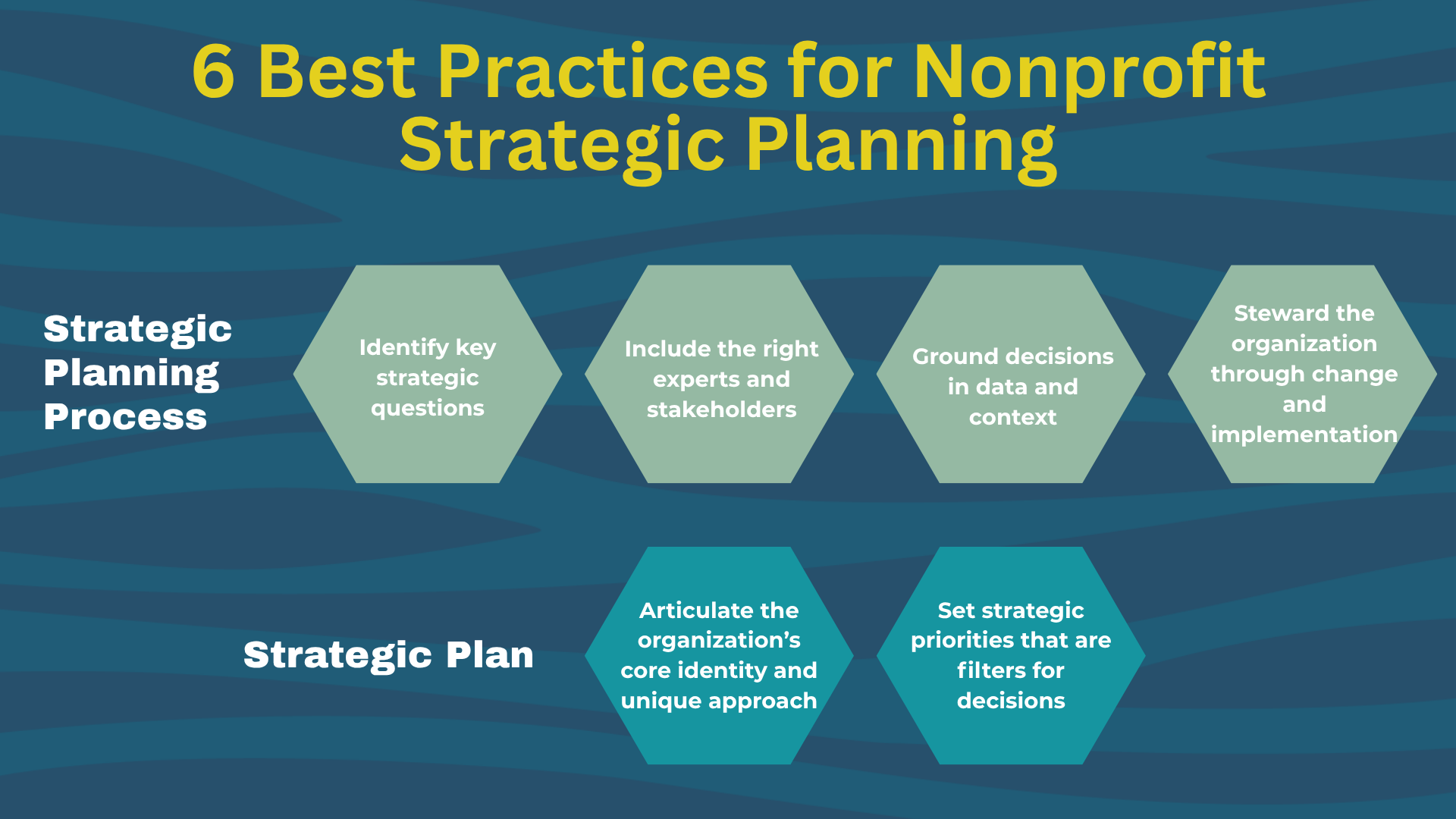
Strategic Planning Process:
Identify key strategic questions. Articulate these at the start of the process, and ground the planning process in answering them. Strategic questions are substantial business questions facing the organization, for example, should we expand to this new geographic area?
Include the right experts and stakeholders. These partners inform the context and content of your strategic plan, and they should be included in the process of developing your plan. Experts are those most impacted by your organization’s work, such as clients and others including staff, board members, partners, subject matter experts, other nonprofits in the field, and funders. An inclusive process does not necessarily mean every decision is made by consensus, but rather that all input is listened to and considered.
Ground decisions in data and context. Use data to understand your organization’s position in the field, the landscape, needs, and opportunities, and to help inform decisions. Data sources include input from internal and external constituents and secondary research, such as local reports and publications. Data informs strategy; it does not replace judgment.
Steward the organization through change and implementation. Strategic planning is a change process. Even positive change can create uncertainty, fatigue, or anxiety for staff and constituents. Changes will impact your team and community. Take care of staff, partners, and people you serve, and gently steward the change process. An inclusive process co-created with staff, board, clients, and other constituents helps bring their wisdom to the plan and successfully engage them in implementation.
Strategic Plan:
The plan articulates the organization’s core identity and the unique approach that the organization will take to achieving its mission, including what the organization will do and won’t do, and for whom, where, and how. This includes articulation of the organization’s theory of change, which describes the mechanism by which an organization will translate its resources and programs into meaningful, measurable impact.
Set strategic priorities that are filters for decisions. These priorities are broad pillars that focus on how you achieve your intended impact and mission, as well as determine what activities you should start, stop, and continue. Develop clearly defined goals and actions for each strategic pillar. Ensure your strategic priorities are realistic and aligned with organizational capacity and resources. Strong strategic plans balance ambition with feasibility and include honest consideration of staffing, funding, infrastructure, governance, and operational readiness. Make sure your strategic priorities are unique to your organization. If the priorities could apply just as well to any organization, then they are not a strategy.
Throughout the process, beware of developing a strategic plan that is not strategic. As we’ve written about here, strategy is not a to-do list or a work plan. A strategic plan is a coordinated set of actions designed to achieve your organization’s mission while overcoming significant challenges.